In shortMoraine Lake vs Lake Louise comes down to access and season. Lake Louise keeps a drivable road to its shore in every month of the year; Moraine Lake has a road that no private car may use in any month, with the permitted list stopping at Parks Canada shuttles, licensed commercial operators, accessible-placard holders and Moraine Lake Lodge guests, and a lake that receives visitors only from early June to mid-October. Most visitors see both the same day.
Closed all yearMoraine Lake Road to cars
June 1 to October 122026 Moraine shuttle season
4 am and 5 amsunrise shuttle departures
from CAD 400sunrise tour, 7 hours
Moraine Lake vs Lake Louise: the differences that matter
The two lakes share a colour and little else. Both run turquoise because glacial meltwater carries fine rock flour into them and the suspended sediment refracts the sunlight; the load arrives in spring and early summer, and the shade moves with the light through the day. Moraine Lake lies beneath the wall of summits known as the Valley of the Ten Peaks, and Parks Canada manages it as backcountry: the facilities are pit toilets, and there is no running water, Wi-Fi, cell signal or lighting on the road. Lake Louise sits at 1,731 m, holds about 2.4 km of water at 70 m deep, has a hotel on its shore, and Mount Victoria with its hanging Victoria Glacier closes the head of the valley.
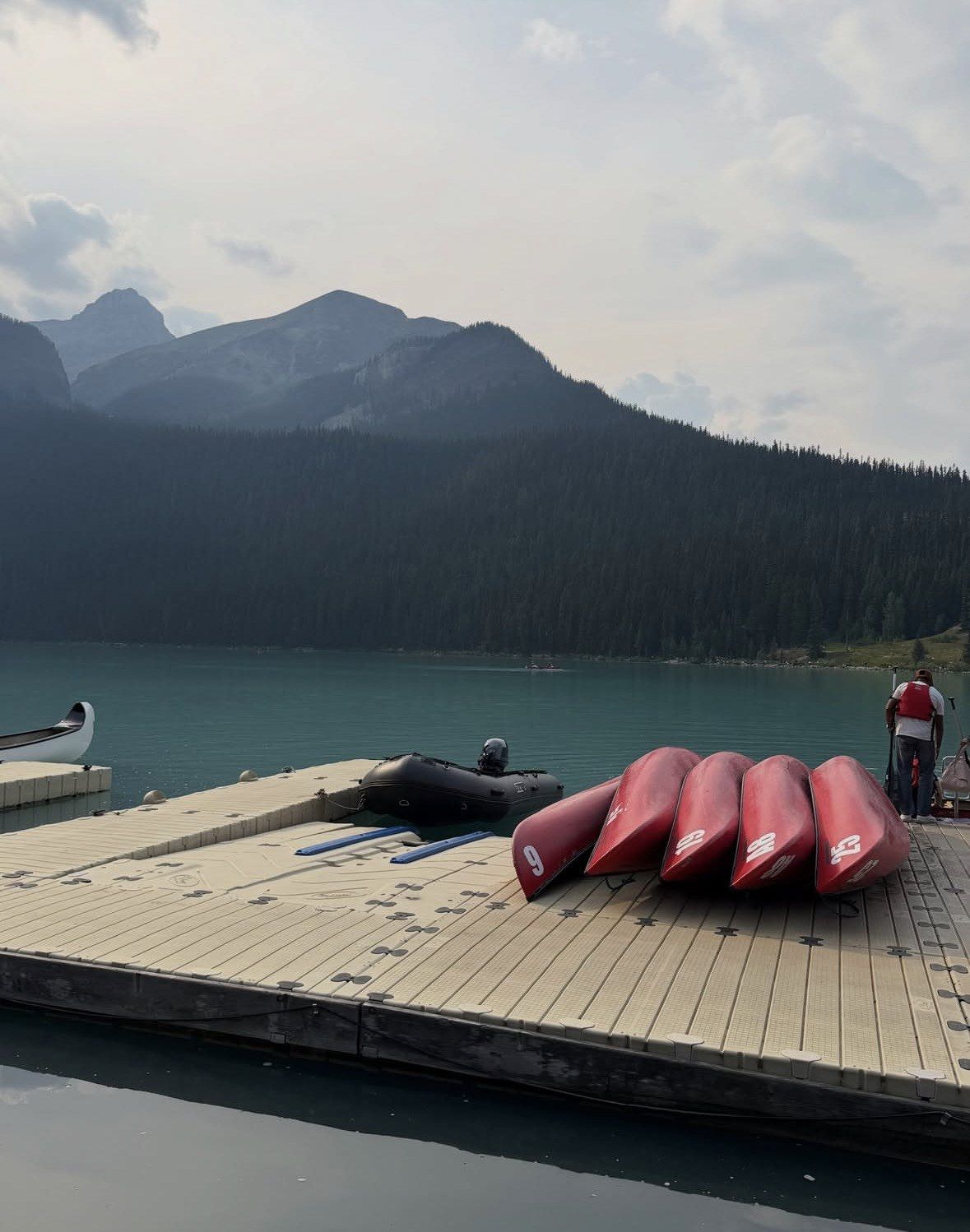
Size is the one comparison the official sources will not settle, because Parks Canada publishes no surface area or depth for Moraine Lake. What you do on each shore differs more than the dimensions anyway. Lake Louise has a flat lakeshore path, canoe rental from June through October with the docks usually opening in mid-June, and two teahouse climbs that start at the water. At Moraine the standard move is the short climb onto the rockpile at the outflow end for the view back down the length of the lake.
Crowds behave differently as well. Lake Louise rations access through its car park: in peak season the lakeshore lots are taken extremely early and stay taken all day, and the tourism board marks June through October as the heaviest stretch of the year. Moraine Lake never builds a parking queue, because no private car reaches it; the number of people on the shore at 9 am is whatever the shuttles and licensed tour vehicles have delivered.
| Lake Louise | Moraine Lake |
|---|
| Open | Community and lakeshore open year-round | Early June to mid-October |
|---|
| Personal vehicles | Allowed up to the shore all year, though peak-season lots are taken extremely early and stay taken all day | Not permitted on Moraine Lake Road at any time of year |
|---|
| Who may drive the access road | Any visitor | Parks Canada shuttles, operators with a Licence of Occupation, accessible-placard holders, Moraine Lake Lodge guests |
|---|
| At the lake | Hotel on the shore, canoe rental June through October, visitor centre in the village | Pit toilets at the lake; water, Wi-Fi, cell service and road lighting are all absent |
|---|
| Official measurements | 1,731 m elevation, about 2.4 km long, 70 m deep | Not published by Parks Canada |
|---|
| Trails from the shore | Two graded climbs from the water: 3.9 km and 495 m of ascent to Lake Agnes, 5.9 km and 595 m to the Plain of Six Glaciers | Area trails carrying routine seasonal bear restrictions and a possible group-of-four rule |
|---|
| 2026 Parks Canada shuttle | May 15 to October 12 | June 1 to October 12, with the Lake Connector |
|---|
Can you drive to Moraine Lake?
No, and not in any month. The closure on Moraine Lake Road applies to personal vehicles every day of the year, winter included. Four kinds of traffic get through the gate: Parks Canada shuttles, commercial operators that hold a Parks Canada Licence of Occupation, drivers displaying an accessible placard and guests of Moraine Lake Lodge. Setting an alarm does not change that, so plans built around parking at the lake at dawn fail before they start.
Lake Louise works the other way. You can drive up from the village to the lakeshore in any month of the year, with the caveat that the lots in peak season are taken long before most visitors are awake. Parks Canada states the best way to see both lakes is by its shuttle or by Roam Public Transit rather than by private car, and Roam Route 8X runs daily all year to the Lake Louise Lakeshore. Route 8X does not continue to Moraine Lake.
The shuttle is not something you can fall back on at the last minute: every Parks Canada departure is reservation-only, and no seats are sold at the Park and Ride on the day. A licensed tour answers the same problem from the other direction, because the operator already holds the permission to use the road and Moraine Lake access sits inside the ticket during its season. Sort your return before you go up: there is no cell service at the lake, and anyone who misses the last departure has to arrange their own way back.
A licensed vehicle on Moraine Lake Road
Because only licensed operators may use the road, this 8 to 11 hour day from CAD 88 covers Moraine Lake admission inside its season along with Lake Louise and Emerald Lake in Yoho, with a local guide driving.
★ 4.8/5 · 533 reviews
Two lakes, two calendars
Lake Louise is a twelve-month destination. Nothing shuts at the village or along the lakeshore when the season turns; the water usually freezes solid around mid-December, and the Fairmont Chateau Lake Louise maintains a natural rink on top of it, lit after dark for evening skating. High lakes including Lake Louise begin to thaw in early June, which is why a mid-May visit can show white ice rather than colour.
Moraine Lake runs a short season, early June to mid-October. The 2026 timetable shows the gap plainly: the Lake Louise Lakeshore shuttle ran from May 15 to October 12, while the Moraine Lake shuttle and the Lake Connector worked only from June 1 to October 12, weather permitting. Dates for the next season had not been published when this page was written, so look them up officially before you lock in a travel date. Tours whose Moraine Lake admission is seasonal substitute other stops outside that window.
Inside the season, two dates shape the day. Alpine hiking gets going in late June, and larch colour near Lake Louise peaks from the last week of September into the first week of October, as monthly averages fall from 15 C and 0 C in September to 8 C and -5 C in October. The teahouse trails above Lake Louise are listed June through October, and Parks Canada warns they are unsafe from November through mid-May because of avalanche risk.
The rockpile, the shoreline and the trails from each shore
The view most people come to Moraine Lake for is from the rockpile, the mound of debris at the outflow end, reached by a short climb from the shore path. It frames the water and the peaks behind it in one go, and it is where arriving shuttle and tour passengers gather, so the quieter stretches are along the shoreline beyond it.
At Lake Louise the shoreline walk is flat and runs beside 2.4 km of water, and two graded climbs leave from the same place. Parks Canada measures the shorter one at 3.9 km each way with 495 m of ascent to Lake Agnes, moderate, 2.5 to 3 hours for the round trip, and the longer one at 5.9 km one way with 595 m of gain and 250 m of loss to the Plain of Six Glaciers, around 4 hours. Banff & Lake Louise Tourism publishes slightly shorter figures for the same paths, so read the trail report on the day.
Trails leaving Moraine Lake sit in terrain Parks Canada lists among its routine seasonal bear restrictions, together with Bryant Creek and the Lake Minnewanka trails. Where Group Access is imposed, hikers must travel in a tight group of four or more, so check the live trail report before you count on Larch Valley, Sentinel Pass, Eiffel Lake, Paradise Valley or Consolation Lakes. Keep 100 m between you and any bear, wolf, cougar or coyote and 30 m from deer, elk, sheep and moose; feeding or disturbing an animal breaks park law.
Sunrise at the quiet end of the day
Sunrise is the one hour when Moraine Lake is genuinely empty, and reaching it then is deliberately awkward. The Parks Canada sunrise service, Alpine Start, has only two departures a day, at 4 am and 5 am, and it leaves from the Lake Louise Lakeshore lot rather than from the Park and Ride, which makes it a separate exercise from a normal shuttle day.
Guided sunrise departures start earlier still, because they collect you at your accommodation. On the premium sunrise tour the pickups fall roughly between 3:25 am and 3:55 am in the June 1 to July 15 band, then shift later through the season to about 5:25 am to 6:55 am from October 1 to 12, with readiness ten minutes before departure. Pickup points include hotel fronts on Banff Ave, the Roam bus stop on Tunnel Mtn Rd, the loading zone on Elk Street by the roundabout, the zone outside Fairmont Shops and the bus loading zone in the Samson Mall parking lot.
A head torch comes with the ticket, which counts for something at a lake with no road lighting, and the group is capped at 12 with a guide trained in photography and storytelling. Seven hours is what the whole outing takes, from CAD 400, rated 4.9 ★ (312 reviews); breakfast is a croissant with ham, egg and sauteed vegetables, hot drinks come with it, your own bottle gets refilled, and you go home with a Polaroid. If you have no intention of using that light, take a later departure instead and see both lakes at a civilised hour.
Seeing both in one day: which option to book
Do both. The Lake Connector between the two lakes runs every 30 minutes from 7 am to 6 pm, with the last departure from Moraine Lake at 6:00 pm, so inside the June to mid-October window the pair fits one day without a sprint. The decision worth spending time on is which vehicle gets you onto Moraine Lake Road, since that is the part you cannot improvise.
For empty shoreline and photographs, the premium sunrise tour is the only option on this site that puts you at Moraine Lake before the day's traffic arrives, with hotel pickup at select Banff and Lake Louise locations and breakfast on board. For a longer day that adds a second national park, the Lake Louise, Moraine Lake and Emerald Lake trip through Yoho runs 8 to 11 hours from CAD 88, rated 4.8 ★ (533 reviews), in an air-conditioned van with a local guide driving. Moraine Lake admission is included with the ticket from June 1 to October 11, and admission to Marble/Johnston Canyon or Peyto Lake is included instead from October 12 to May 31.
- Based in Banff or Lake Louise, photography is the point, and a pickup before 4 am in midsummer is acceptable: take the sunrise tour, 7 hours, max 12 guests.
- Want both lakes plus Emerald Lake and a stop in Yoho on a normal morning start: the 8 to 11 hour three-lake day from CAD 88, with the Calgary pickup departing the Harry Hays Building bus stop at 7:30 am.
- Travelling outside the Moraine Lake season: the same three-lake day swaps in Marble/Johnston Canyon or Peyto Lake, crampons are carried in winter, and Lake Louise itself stays open.
- You choose Banff Avenue or Bow Falls as the last stop on the three-lake day; meals and a suggested guide tip of CAD 12 cash per person are extra.
- Both bookings can be cancelled up to 24 hours before the scheduled departure time.
Questions people ask
Moraine Lake or Lake Louise: which is better if I only have one morning?
Outside early June to mid-October the question answers itself, because Moraine Lake is not accessible and Lake Louise is open year-round. Inside the season, pick Moraine Lake if the peaks and the rockpile view are what you came for, and Lake Louise if you want a flat lakeshore walk, a canoe between June and October or a teahouse climb. Most visitors manage both in a single day.
Is Moraine Lake open in winter?
No. The lake takes visitors from early June to mid-October only, and even within that window no personal vehicle may be driven up to it, since the road closure to private cars holds in every month. Lake Louise stays open all year: it usually freezes solid around mid-December, and the hotel runs a natural rink on the ice, lit for evening skating.
What should I bring to Moraine Lake?
Carry your own water, because the lake is managed as backcountry with pit toilets and no running water. There is no cell service and no Wi-Fi, so download maps and timetables in the village beforehand. Mornings are cold even in high summer, with June averaging 17 C by day and 3 C overnight at this elevation, and there is no lighting at the lake or on the road.
Do I need a park pass as well as a tour ticket?
Admission to Banff National Park is required and is charged separately from transport, so check what your ticket covers before you travel. Moraine Lake access is included with the ticket on both tours featured here during the season it is open. A pass is also needed simply to drive the Icefields Parkway and the Bow Valley Parkway, even without stopping.
Why is the water turquoise, and when does the colour look strongest?
Melting glaciers grind rock flour that meltwater carries into the lakes, and the suspended sediment refracts sunlight into the blue-green. The sediment load arrives in spring and early summer, and the lakes can be expected to glow through the summer months. The shade also changes with the light through the day, so the same shoreline looks different at 7 am and at 4 pm.
Read also